
Judgement

Image description: a black and white picture shows a couple pointing and viewing art in an art gallery. Below is the title Judgement.
I’ve realised my love for travel and food is linked to my nosiness to know and understand people, and why I really enjoy my job working with lots of different musicians and pupils.
When we travel, I enjoy figuring out these unique puzzle pieces. Every part of the journey gives away more clues, from the internet research before, to the airport and security queues.
What could be better than seeing how another ‘tribe’ of people describe themselves through the art they make, and the art they value? And all the arts count in this endeavour, tv, music, books, adverts, all helping to build a picture.
And so we found ourselves in an art gallery, happy to be welcomed into its smooth polished floors and air-conditioned rooms. A serene refuge from the hot, bustling, dusty streets for at least a quiet few hours with occasional benches to admire the art.
I used to visit galleries and treat every picture with equal time, trying to give it time and allowing it to speak to me, but now I’m much less patient and probably less pretentious! I’m happy to waft around and only stop at the pieces that really grab my attention for some reason. I let my gut reaction guide me, turning off any preconceived ideas of good and bad, not reading names, and choosing my personal favourites from the visit because they are unusual, because they capture a feeling or emotion like a forgotten summers day, describing an anxious wait, translating sunlight and shadows into oil paint.
At this particular gallery it seemed like there was one of almost every ‘famous’ historical painter you have ever studied at school. Some were recognisable and almost familiar in style, and some were not. As though ‘from the school of’ or ‘influenced by’ might lead you to stop longer and consider its’ merit. The paintings I might have tried to give more time to because of who they were by rather than how they made me feel. But the truth was many of the big names were not my favourites, and many were instantly forgettable. Their famous name might make you stop, but the painting was not particularly moving or descriptive.
It made me wonder if these great well-known names had any idea these pictures would one day be displayed in an art gallery as a prized possession? Were they sketches? Or maybe they hated them and didn’t get around to painting over it. Would they be horrified to know some of these made it out of the back of the cupboard? I read an account recently about an artist who regularly reconsidered a painting she was working on and painted over it. She chose to scrap hours of work because it wasn’t going the way she wanted, to the consternation of others who had watched the artwork being created.
We don’t just make good art. We make art, and sometimes it is judged to be good, and sometimes it is not.
“Don’t think about making art, just get it done.
Let everyone else decide if it’s good or bad, whether they love it or hate it.
While they are deciding, make even more art.”
In music -and singing- we are too often perfectionists who are judged harshly for less than perfect performances by not only ourselves but others. There is an old saying that ‘you are only as good as your last performance’ which is frankly ridiculous!
Our bodies and minds fluctuate with hormones, life drama, energy levels, illness and so on. So why are we not as good at accepting that these things happen and affect our art sometimes? Why are we aiming for perfection if it is unachievable?
If we restrict ourselves to only making ‘perfect art’ when our bodies and minds are truly ready or cooperative, how often would we perform? Would this be helpful to our artistry or enjoyment? Is good art achieved in a perfect environment?
I remind myself to be kind, and teach my pupils to be kind. We sing best free of the idea of ‘perfect’. The act of making art should not be done under the restrictions of deciding whether or not it is any good, but with the freedom and vibrancy released from creation for the point of communicating emotion and stories. These are the pieces of art that I find most move me, and the artists who I admire on the concert and opera platform.
A perfect performance technically and environmentally is not necessarily the one that moves me or that I wish to experience again. Lets all aim to be kinder.

What do I need for my lesson?

Whether a seasoned regular or coming for your very first lesson, here are a few things you might want to bring or think about to attend your lesson, and to get the most out of the experience.
Music
What have you been studying/learning? Bring that, and bring a second copy to share with your teacher/pianist.
Any music you are performing with your choir, church solos, stage shows. Even if you don’t plan to sing it, it may become relevant for technical or performance reasons.
A pencil
Whether working digitally or with paper music, bring a pencil to make notes and mark your music.
A notebook, or recorder to record the lesson if agreed with your teacher
Either are fine with me, but it makes sense to be able to write down broader technical and performance ideas for your practise later.
An open mind
This is your time to work on your goals - so to help you do this fully come ready to play, work, experiment, and learn. Put aside the everyday distractions for now and enjoy this time to concentrate on your voice and performance.
“You do get better at even the things you’re terrible at, if you practice.”
Before the lesson
What you wear
Think about wearing something you are comfortable in, that allows you to move and work physically. We will be doing stretches, and sometimes use weights/pilates bands and other equipment as part of our work together.
Food and drink
Make sure you have eaten and drunk enough before the lesson to feel comfortable standing and working physically. If you wish to drink water during the lesson, lay it out to bring with you. By personal preference, I prefer not to drink while singing, but I don’t mind if you do.
Warm-up
You may wish to have a short vocalise or warm-up before you arrive, check in with your voice and see how it feels today, if you are experiencing anything different you can bring this up at the start of the lesson. This might also include feeling if you have any tension.
Lastly, a little reassurance. I am human, I have made many mistakes, I have sometimes found practise hard to fit into life or had other things going on that make work/life tricky. Please feel free to let me know of anything that might affect our session together that you think I should know about. I fit around you and your needs.
I do not expect that every pupil arrives a perfect and finished product - that simply isn’t real life! Sometimes the best lessons are the ones that happen responding to the voice and singer as they turn up that day. So please don’t worry that you feel you should have done x, y, or z. Hopefully all teachers feel this way and should be understanding!

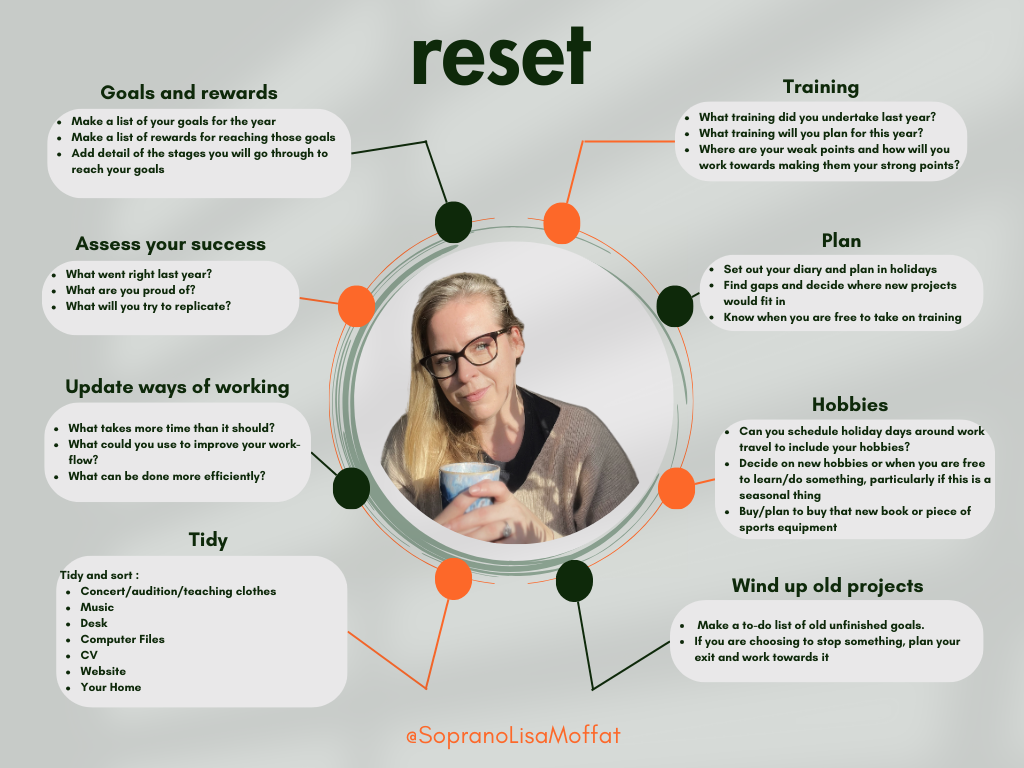
reset
A guide to reviewing and resetting your work as a musician and teacher
“You’ll never do a whole lot unless you’re brave enough to try.”
January is a month of making changes, so why not take the time to assess your business as a musician or in the field you work in, and decide what you want to take forward, and what you can let go of.
Goals and Rewards
Make a list of your goals for the year
How brave do you feel? Maybe this list has some simple easy goals and also some amazing and difficult goals, aim big!
Performances, work on languages, new repertoire, new genre you have not yet explored, working with new people, new teaching jobs/pupils, changing your support/additional job that helps you fund your music goals.
Make a list of rewards for reaching those goals
We know we all work better when there is a reward - be that money, travel/holidays, listening to a favourite piece of music after a hard day, or maybe purchasing that expensive score you have wanted for a while (yeah, this is my weakness… they might be a particular shade of blue… and start with a B)
When you are self-employed, build in your work ‘bonus’ to your work plan.
Add detail of the stages you will go through to reach your goals
Don’t just make a list of big goals, plan how you will get there. Some goals will be easy to reach in one stage, some might be a long term project with many stages to tick off along the way.
Assess your Success
What went right last year?
What are you proud of?
It’s time, you have permission to pat yourself firmly on the back, and hold your own personal awards ceremony! Best of all, it’s all about you. List all your achievements and thoroughly asses what you have to be proud of - include financial, emotional, and mental achievements
What will you try to replicate?
Update Ways of Working
What takes more time than it should?
What could you use to improve your work-flow?
Are your accounts taking ages? are you slow on social media? Are you keeping track efficiently of pupils and payments? Are there any tools like apps or software that would save you time? Remember time is money and effort - often spending money is worth it if your life is easier or you are taking less time to do tasks you don’t enjoy.
What can be done more efficiently
Is your teaching scheduled neatly together or taking up random times in your week? Would your commute be easier/quicker if done at a different time if you worked different hours? Could you use fewer paid childcare hours if you moved your work schedule/teaching?
Tidy
Tidy and sort :
Concert/audition/teaching clothes
Sell/post/give away/donate what is no longer suitable or does not fit
Music
It’s easier to find if it is stored in a system you find easy to use.
Desk
Computer Files
Keep old files/photos in folders for their year, and make a new folder for the current files
CV
Website
Your Home
Training
What training did you undertake last year?
What training will you plan for this year?
Where are your weak points and how will you work towards making them your strong points?
Plan
Set out your diary and plan in holidays
It’s very easy to fail to take a break if you get offered work - but it is not good for us or our friends/family. Make sure it goes in the diary even if it can be moved. Schedule work like social media to automatically load while you are taking a break.
Find gaps and decide where new projects would fit in
Know when you are free to take on training
Hobbies
Can you schedule holiday days around work travel to include your hobbies?
Decide on new hobbies or when you are free to learn/do something, particularly if this is a seasonal thing
Buy/plan to buy that new book or piece of sports equipment
Wind up Old Projects
Make a to-do list of old unfinished goals.
Sweep up all the old half finished things into one list. Plan what you need to do to finish them all off, and how you will do that.
If you are choosing to stop something, plan your exit and work towards it
If you plan to change jobs, or finish certain teaching jobs, plan how you will step back and when, build in a change-over time if you are handing a job to someone else.

sea
Sea themed music that celebrates the power and beauty of the sea.

Exploring music written about the sea
This month we are celebrating the sea, and the music we that is written about the sea.
This list is a few of the diverse pieces written from more recent centuries, and it is also a playlist on youtube. Click the link at the bottom to read about each piece while listening to them too.
Feel free to comment and add your own favourites in the comments box - what have I missed out?
Prelude in G, Op 28, no.3, Chopin
Used in the BBC adaptation of Persuasion which features the sea-faring exploits of Captain Wentworth, this Chopin prelude seems to capture the ever moving and reflecting water which is present in so many Sea themed compositions.
Sirèns, Debussy, ‘La Mer’
Would it be the sea if a composer wasn’t writing about mermaids or Sirens luring sailors to their death? Here Debussy writes soaring melismas for the choir to represent those other-worldly creatures.
O Waly waly - Britten, Folk Song Arrangements
This folk song and arrangement is a favourite with me and many of my pupils. The technical aspects of performing are matched by the job of the performer to be a supreme storyteller.
4 Sea Interludes: Storm, Britten, ‘Peter Grimes’
There were 4 sea interludes to choose from, and I chose the storm as we haven’t had any music yet that really captures the strength and danger of the sea.
Here Britten really uses his powers of orchestration and melody to suggest the crashing sea on rocks, spray, wind, and surge.
My Gallant Crew, Sullivan, ‘HMS Pinafore’
As much as we respect the sea, we also enjoy satire and gently poking fun at authority and those in power. In this Sullivan song from HMS Pinafore the Navy and privilege are gently mocked.
Leave Her Johnny, Sea Shanty, ‘Assasins Creed’
The Shanty tradition is alive and well in this shanty used in the ‘Assasins Creed’ computer games. In recent years a sea shanty went viral as young people on tiktok enjoyed the art form and recorded their own performances.
La Mer, performed by Charles Trenet
To finish, we have French singer Chalres Trenet with his celebration of holidays and beach life. His rendition sums up the hot summer relaxing by the ocean.